On failing at my first Kaggle competition (3/n)
In the second part we talked about transformer heads and features.
In this part, we will dive into credit assignment and reward hacking problems that I faced.
Giving +1 reward when you win a game and -1 when you lose is clean and eventually you want to reach that state where it suffices but before you get there, you need more signals, i.e. dense rewards to teach the agent the behavior you want.
The problem with dense rewards is that it’s hard to get it right — it can either be exploited, or has adverse side effect that will impact the overall performance.
Let’s add more context so you can engage with the problem.
In a 500 step game, how will you know the move at step 3 was beneficial for the overall outcome of the game or not?
In order for reward to work in RL, credit assignment needs to work as well. How to attribute credit correctly is the problem.
With sparse rewards like +1/-1, it’s hard to do credit assignment correctly, therefore you need dense rewards to drive the behavior and develop the traits you want in your agent.
If you value capturing a planet early, you can give additional reward for captures in steps less than 50; thinking along these lines, you’d say we should value higher production planets over lower production so let’s give it some reward so it knows to rank higher production planets above lower ones. As you can imagine this line of thinking is error prone and also feels more like modeling heuristics — not via if-else loops but reward models.
You might wonder wasn’t the entire idea of RL and self play was that agent figures this out on its own and we don’t have to hard code these values?
And also the obvious question, how the hell can we weight a better long term move in comparison to greedy short term move? For example abandoning a planet is better for the overall goal of the team, but the nearby planet might still send all its ships/garrison to save the planet if you reward saving highly.
And what about capturing a planet at step 5 versus step 50 should have different rewards right?
Yes, these temporal rewards are managed via discounted rewards, Bellman equations solve it perfectly.
Future rewards are given less weight in comparison to immediate rewards. And that weight is a function of time/steps, reduces further you go. Overall value at a given state is the sum of immediate reward and discounted future value.
In a single agent system, credit assignment is relatively easier, because only one agent’s action determines the end result. In a multi agent system like Orbit Wars, where each planet’s action can impact the team’s result, we need to do some aggregation to traverse the credit back to the action that produced it.
But our system didn’t really do this. At every step, it collected a single scalar advantage that says this turn was better or worse. But this step is not a single decision, it’s a bundle of independent per planet decisions — one planet attacks a neutral planet, another reinforces a frontier planet against the enemy and third one sits idle. When we compute policy gradient, we multiply the step’s scalar advantage with log probabilities of all those per planet choices. The effect is that every planet’s decision receives exactly the same credit or blame, regardless of which one was actually responsible for the outcome. A turn that wins reinforces lazy idle behavior alongside a decisive attack; a turn that loses punishes a well-timed reinforcement.
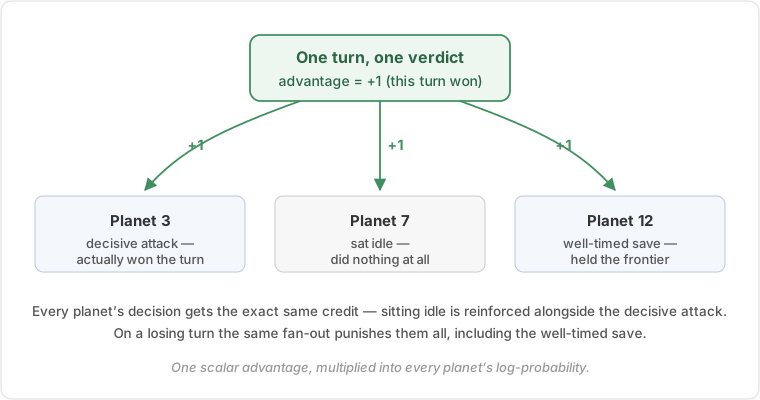
This multi-agent credit problem wasn’t something hidden, but the multiple attempts at overcoming it resulted in different kinds of failures.
Before I describe the attempts, it’d be worth knowing a little about PPO, Proximal Policy Optimization. It’s a policy gradient RL algorithm, based on actor critic architecture. Actor decides what action to take, and critic evaluates how good/bad a given state is V(s). Advantage is derived from the critic (A = r + γV(s′) − V(s)). So far we have talked about fire/ship/target heads, they are actors in our model; along with these three heads, there is another value head, and that’s the critic. We can have two networks, one for actor and one for critic, but they can also share the neural net, and that’s what happens in our entity transformer.
Actor’s actions are controlled by the policy, and during training, big step updates to the policy can make it collapse; in order to stabilize it PPO clips the policy such that it doesn’t go too far, and stays within a trusted region. What I want you to remember is this clipping has nothing to do with credit assignment or calculation of advantages, that’s the job for the critic. I explored per planet clipping, one trust region per planet, together they get summed after. This resulted in under-commitment of ships.
Following this, we moved to fixing the credit assignment; per planet advantage instead of single shared advantage for all planets. This factorization destabilized training into a hoarding policy (visible first as the value collapsing).
(You’ll notice I keep slipping between “I” and “we”. The “we” is me and the LLM. That partnership deserves its own post.)
And we concluded that joint credit is the reason baseline was working, where all planets coupled under one advantage
The second attempt later was to explore the ideal way of calculating counterfactuals to isolate per planet contribution — what would the outcome be if this planet hadn’t acted, while other planets acted as they did?
Turned out structural credit assignment wasn’t the problem, because even with the credit correctly assigned, the behavior it would reinforce (under concentrated and under-expanded play) is the same losing equilibrium self-play keeps forming. What I concluded was that actions worth crediting, traits worth developing weren’t being produced in the first place. And then would jump to improving the training signal of self play opponents, such that they’d force the agent to produce these actions, and learn that it can win by these actions.
I found it difficult to trust these conclusions because I kept going in cycles; a simple bug could’ve led to the wrong conclusion and dropping of a direction worth pursuing. It might still be true. Once I know one of the top agents won with this approach, I shall revisit with fresh eyes hunting for bugs and bad assumptions. (Would it have been different had I written all the code myself?)
Why isn’t agent producing these actions?
Because the policy generates the data. You can only reach states that your policy takes you towards. Unlike supervised learning where the training of the model doesn’t affect the data it trains on, in self play it does.
current policy π  ──acts in the env──►  rollout (states, actions, rewards)
        ▲                                          │
        └────────── PPO update on that data ───────┘
If the current policy doesn’t send 50 ships to contested neutral planets, then you collect zero samples of how that turns out. The policy can be blind to its own blind spots and stay that way.
Because of this continuous feedback cycle in RL, a bad update in policy compounds instead of getting washed out. Policy gets worse, it generates worse data, then trains on worse data.
Data’s life is dependent on how many PPO epochs you use the data for.
It can be short, if number of PPO epochs is 1.
Policy used to generate the rollout gets updated at the end of the rollout and that data is thrown away.
If number of PPOs epochs is 2, then a second pass is done over the same data.
If it’s 4, then 4 passes over same data, so more learning, and policy will drift further from the initial policy that generated the data.
More epochs = More reuse = More sample efficient but more off-policy drift.
Adding external opponents to the pool will increase the state/board distribution your agent faces and learns from but it won’t fix the agent’s blind spots.
What will then?
Entropy, curriculum, and reward signal.
Entropy controls the exploration. Sampling is our exploration. In training we sample the actions and perform less probable actions as well to collect the advantage, if it’s positive then the probability of that action increases. This is also why on-policy data is narrow, but live. The spread of actions it explores is dictated by the current distribution. Sharp logits in current distribution -> low entropy -> little exploration -> narrow data. In order to prevent this entropy collapse, we had entropy bonus coefficient that pushes the distributions to stay flatter so sampling can keep exploring.
sample → explore → generate diverse on-policy data → advantage reinforces the good draws → distribution sharpens → less exploration.
Entropy bonus fights the sharpening.
This nicely takes us to the gaps I had in my training - evaluation setup.
Despite knowing it’s fatally important to keep them synced, I fell for it a few times.
Some differences are expected, like the win rate during training will not be identical to win rate during evals, because of sampling. At inference/eval, we use argmax, and take the action with highest probability.
Others should not have gone unnoticed, like comets were missing from training. So it was training on a simplified version during training and at eval time the game was different, as comets start spawning from step 50.
Even after fixing the physics, the policy mis-saw them, because is_comet was still hardcoded to 0. Stale values in features predicted wrong orbit for the comets.
And then there were wrong assumptions baked in from the initial phase, that must’ve been added to keep the game simple, like limit max moves to 8 and max owned planets to 16, and one action per slot. None of these limitations existed in the actual kaggle environment, but were added at start and I didn’t pay enough attention to diligently scrutinize them.
Now some notes so I don’t find myself in the mess of metrics.
Instead of relying on manually watching the game to determine agent’s performance and gaps, I had metrics to understand where it was lagging.
That was a mistake on its own, but I also over relied on the metrics. And aggregation comes with its own flaws, that make it harder to reason. Like if the fire ratio metric is high, does it mean the agent has a spraying problem? Not necessarily, it needs to be tuned based on empire size, and the phase of the game; towards the end if the agent is firing a lot, that’s likely the right game play. And if we do have a lot of planets then the number can go higher because of end game. So they need to be bucketed based on game phase, like early game (<50 steps), mid game, etc.
Mean is not always right to use, for example, the fleet size that’s being sent, one huge fleet size could skew the number higher.
Agent often used to send 1 ship probes that didn’t result in capture of planet; this behavior was learned from self-play. It could’ve happened because it was getting positive reward for it. Or definitely not getting penalized for it. Again, this metric was 0 in the initial phases, and rose high towards the end. Whether or not to allow the agent to continue to train after it was something I still can’t confidently conclude. This cycle happened multiple times, when a metric I was chasing was later concluded to be flawed after deeper investigation. So lesson is to have fewer metrics that you understand deeply — how they are being calculated, at what point is the calculation happening, what information is being lost during reduction/aggregation.
A lot of these mistakes might have been avoided if I had written the code myself. I say might, because bugs and gaps would still remain in human written code. But the level of overall comprehensive understanding is higher when you write and curate each line yourself, after careful thought and consideration. A better workflow I’ve discovered involves spending a lot of time reviewing the generated code and take the reins yourself if agent can’t seem to follow your instructions as you’d like.
Code bloat, flop, and other perils of using LLMs to generate code is beyond the scope of this post.
Before closing, let me compress three posts into one answer. Why did I fail?
The agent plateaued because self-play kept reforming the same equilibrium — under-expanded, under-concentrated play — and the planner agents at the top punished exactly that.
Every fix I tried — rewards, credit assignment, opponent pools — ran into the same wall: the policy generates its own training data, and the winning behaviors were never in that data to be learned from.
And around that core, I made everything slower. I chased metrics I didn’t fully understand, fixed symptoms instead of root causes, let training and evaluation drift apart, and understood my own system less than I should have, because I didn’t write all of it.
Each of these is fixable. That’s what makes it a failure worth writing down.
I wish I had spent more time exploring other ideas that I learned from RL poker like Monte Carlo Tree Search, and found ways outside self-play to overcome the limitations of self-play.
Now, I plan to read the write ups from top 10 agents/kagglers, learn from them, and build future versions of Orbit Wars agent.